
A monthly bookkeeping checklist is a list of tasks you finish at the end of every month to keep your books correct and up to date. It usually covers matching your bank accounts to your records, sorting your transactions, checking what you need to pay and what others need to pay you, handling payroll and sales tax, and reviewing your reports. Doing the same steps each month stops small mistakes from turning into big ones. This guide gives you a 10 step checklist, a simple close calendar, a worked example, and tips for franchise owners. If you want someone else to handle the work, franchise bookkeeping support can take care of these steps for you.
Why Is Monthly Bookkeeping Important for Small Businesses?
Your business can have money in the bank and still have unpaid bills, missing expenses, or errors in its records. Without a monthly review, these problems can go unnoticed and affect your financial decisions. Closing your books each month helps you spot these issues, understand your actual costs, and prepare reliable financial reports. It also makes tax preparation easier and gives you a clearer picture of your business’s financial health.
In a 2020 study in the Journal of Accounting Research, Petro Lisowsky and Michael Minnis studied tax return data from medium and large private firms in the United States. They found that firms with outside debt and trade credit were more likely to produce audited financial statements that follow GAAP, the standard accounting rules in the country. Trade credit simply means buying from a supplier and paying later. Your business may be smaller than the firms in that study, but the idea is the same. People who give you a loan or sell to you on credit want numbers they can trust, and trusted numbers come from books that are closed on time every month.
The 10-Step Monthly Bookkeeping Checklist
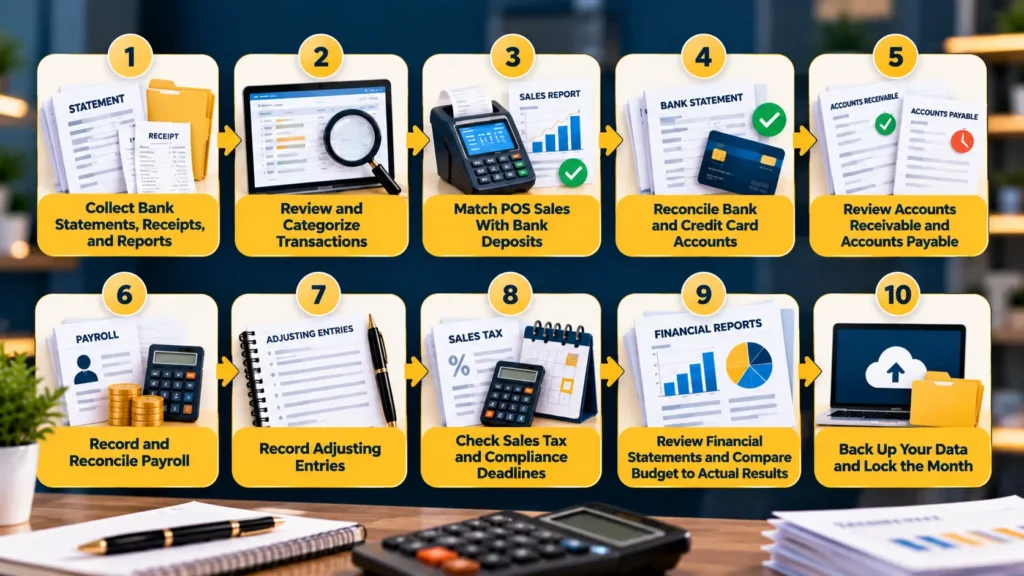
A monthly bookkeeping checklist should cover every important task needed to close your books. Start by gathering and organizing your records, then check transactions, reconcile accounts, review taxes and payroll, and prepare your final reports. Use this checklist to track your progress each month:
- Step 1: Collect bank statements, receipts, and reports.
- Step 2: Review and categorize transactions.
- Step 3: Match POS sales with bank deposits.
- Step 4: Reconcile bank and credit card accounts.
- Step 5: Review accounts receivable and payable.
- Step 6: Record and reconcile payroll.
- Step 7: Record adjusting entries.
- Step 8: Check sales tax and compliance deadlines.
- Step 9: Review financial statements and compare budget to actual results.
- Step 10: Back up your data and lock the month.
Follow the steps below to complete each task and understand what to check before moving to the next one.
Step 1: Collect Bank Statements, Receipts, and Reports
Start by gathering all the financial records you need for the month. These include bank statements, credit card statements, loan statements, receipts, supplier bills, payroll reports, and sales reports from your point of sale (POS) system. Check whether anything is missing before you begin. For example, a missing credit card statement or supplier invoice can delay your month-end close.
Step 2: Review and Categorize Transactions
Review the transactions recorded during the month and make sure each one is assigned to the correct account. This includes sales, purchases, payments, transfers, and other business activity. For example, buying a new oven is different from paying to repair an existing one. A payment to yourself may also need to be recorded differently from a regular business expense, depending on your business structure.
Step 3: Match POS Sales With Bank Deposits
If your business uses a point of sale system, compare its sales reports with the money deposited into your bank account. The amounts may differ because of card processing fees, refunds, tips, sales tax, or payments that have not reached your bank yet. For example, your POS may show $10,000 in card payments, but your bank may receive only $9,800 after the payment processor deducts $200 in fees. The difference does not mean your sales were only $9,800.
Step 4: Reconcile Bank and Credit Card Accounts
Reconciling means comparing the transactions in your books with your bank and credit card statements. The goal is to confirm that recorded transactions are correct and explain any differences. Common differences include checks that have not cleared, deposits still being processed, bank fees, and transactions missing from your books. For example, if your bank statement shows a $150 charge that is missing from your records, find out what the payment was for and record it correctly.
Step 5: Review Accounts Receivable and Accounts Payable
Accounts receivable is money customers owe your business. Accounts payable is money your business owes suppliers and other vendors. Review both lists each month to check overdue invoices, upcoming payments, and amounts that may have been recorded incorrectly. Follow up with customers who have not paid on time. Review supplier bills for due dates, duplicate charges, or missing payments. Even if your business uses cash accounting and does not maintain formal receivable and payable balances, tracking unpaid invoices and upcoming bills helps you plan your cash needs. This review gives you a better idea of the money you expect to receive and the payments your business needs to make.
Step 6: Record and Reconcile Payroll
Review your payroll reports and compare them with the amounts recorded in your books. Check employee wages, employer payroll taxes, deductions, and other payroll costs. Make sure payments leaving your bank match the payroll records. Employee tax withholdings and other payroll amounts that are still due should also be recorded correctly. For example, if your payroll report includes employer taxes that were not recorded in your books, your total labour costs may appear lower than they actually are.
Also review contractor payments separately so they are not confused with employee payroll expenses. Payroll records must stay organized because mistakes can affect financial reports and tax filings. Businesses that need help managing this work can explore payroll processing support.
Step 7: Record Adjusting Entries
Adjusting entries help place income and expenses in the correct accounting period. The adjustments your business needs depend on its accounting method and the type of transactions it records. If your business uses accrual accounting, some expenses need to be recorded in the month they happen, even if you pay them later.
For example, you may use electricity in September but receive the bill in October. Under accrual accounting, the expense generally belongs to September because that is when your business used the electricity. Other adjustments can include insurance paid in advance, depreciation of equipment, and expenses that have been incurred but not yet billed.
A 2025 study published in Advances in Accounting by Philip Hong, Kyonghee Kim, Sukesh Patro, and Kyunghwa Yu found that small businesses using accrual accounting were associated with better access to certain types of credit. This does not prove that using accrual accounting causes better borrowing results, but it highlights a relationship between accounting methods and financial reporting.
Step 8: Check Sales Tax and Compliance Deadlines
If you sell taxable goods or services, the sales tax you collect does not belong to you. It belongs to the state. Each month, check that the sales tax in your books matches your sales reports, and note when the next filing is due. Filing deadlines vary by state and sometimes by city, so look up yours. Also write down other dates coming up, such as payroll tax deposits, franchise reports, and license renewals. Many franchise owners also get help with sales tax so nothing slips.
Step 9: Review Financial Statements and Compare Budget to Actuals
Now read your reports. Start with the profit and loss statement, which shows sales, costs, and profit. Then look at the balance sheet, which shows what you have and what you need to pay, and the cash flow report, which shows how cash moved. Ask simple questions. Did sales rise or fall? Did any cost jump? Is cash lower than you expected? If you have a budget, compare it to your real results and find the biggest gaps.
Step 10: Back Up Your Data and Lock the Month
After completing your reviews and confirming that the records are correct, save a backup of your books and supporting documents. Keep a secure copy outside your main computer, such as in approved cloud storage or another protected location. Then set a closing date or lock the accounting period in your software, if that feature is available. This helps prevent accidental changes to transactions from a month you have already reviewed.
If you discover an error after closing, follow a documented correction process rather than changing old records without explanation. Your month-end close is complete when the balances have been reviewed, important differences have been resolved or explained, and the final records are saved.

Month-End Close Calendar: What to Do and When
A month-end close calendar helps you organize bookkeeping tasks and avoid leaving important work until the last minute. The exact schedule depends on your business size, transaction volume, and when statements or reports become available. Here is a sample 10-day schedule you can adjust to your business.
| Days | Monthly Bookkeeping Tasks |
| Days 1–3 | Collect statements, receipts, payroll reports, and sales records. Review and enter missing transactions. |
| Days 4–7 | Match POS sales with deposits, reconcile accounts, review unpaid invoices and bills, and check payroll and adjusting entries. |
| Days 8–10 | Review tax balances and deadlines, prepare financial reports, compare results with your budget, back up records, and close the month. |
Payroll tax, sales tax, and other filing deadlines should always be handled according to their actual due dates, even if the month-end close is not finished.
Monthly Bookkeeping Example: One Month at a Franchise Location
Let’s look at an example. Say you own one coffee shop franchise. In September, your sales report shows $52,000 in sales and $4,160 in sales tax. Customers paid $56,160 in total. Of this amount, $6,160 was paid in cash and $50,000 by card. Your bank shows two deposits. You deposited the $6,160 in cash. The card company sent you $49,000 because it took a $1,000 fee before sending the money. Your total deposits are $55,160, which is $1,000 less than the total shown in your sales report. This difference is the card fee. You record it as a business expense, and your records now match.
Next, record the sales tax. The $4,160 is not income. It is money you need to pay to the state, so you record it as money your business owes until you pay it. Then, record your franchise fees. Suppose your agreement says you must pay 6% of sales as a royalty fee and 2% as an advertising fee. These fees are $3,120 and $1,040. Your other costs are $17,000 for food and supplies, $16,500 for employee pay, $4,500 for rent, and $2,840 for other expenses. Including the $1,000 card fee, your total costs are $46,000. This leaves you with a profit of $6,000. These rates are examples only.
Monthly Bookkeeping Example: One Month at a Franchise Location
Let’s look at an example. Say you own one coffee shop franchise. In September, your sales report shows $52,000 in sales and $4,160 in sales tax. Customers paid $56,160 in total. Of this amount, $6,160 was paid in cash and $50,000 by card. Your bank shows two deposits. You deposited the $6,160 in cash. The card company sent you $49,000 because it took a $1,000 fee before sending the money. Your total deposits are $55,160, which is $1,000 less than the total shown in your sales report. This difference is the card fee. You record it as a business expense, and your records now match.
Next, record the sales tax. The $4,160 is not income. It is money you need to pay to the state, so you record it as money your business owes until you pay it. Then, record your franchise fees. Suppose your agreement says you must pay 6% of sales as a royalty fee and 2% as an advertising fee. These fees are $3,120 and $1,040. Your other costs are $17,000 for food and supplies, $16,500 for employee pay, $4,500 for rent, and $2,840 for other expenses. Including the $1,000 card fee, your total costs are $46,000. This leaves you with a profit of $6,000. These rates are examples only.
What Changes With More Than One Location?
More locations mean more of everything: bank accounts, sales reports, payroll, and tax filings. Use the same chart of accounts at every location, so a cost has the same name everywhere. Run a separate profit and loss report for each location, so you can see which ones are doing well and which need help. Also watch each franchisor’s due dates, since reports and fees often follow their own schedule. If keeping all of this organized feels like a lot, multi-location bookkeeping puts every store in one clear set of books.
Who Does What: Owner vs. Bookkeeper
Even when you hire help, some jobs stay with you. The bookkeeper collects records, does the reconciliations, sorts transactions, prepares reports, and asks questions when something looks off. You approve payments, answer questions about unusual items, read the reports, and make decisions from them. You should also control bank access and approve any change to vendor or payment details. This system keeps you in charge of your money.
5 Common Month-End Mistakes and How to Avoid Them
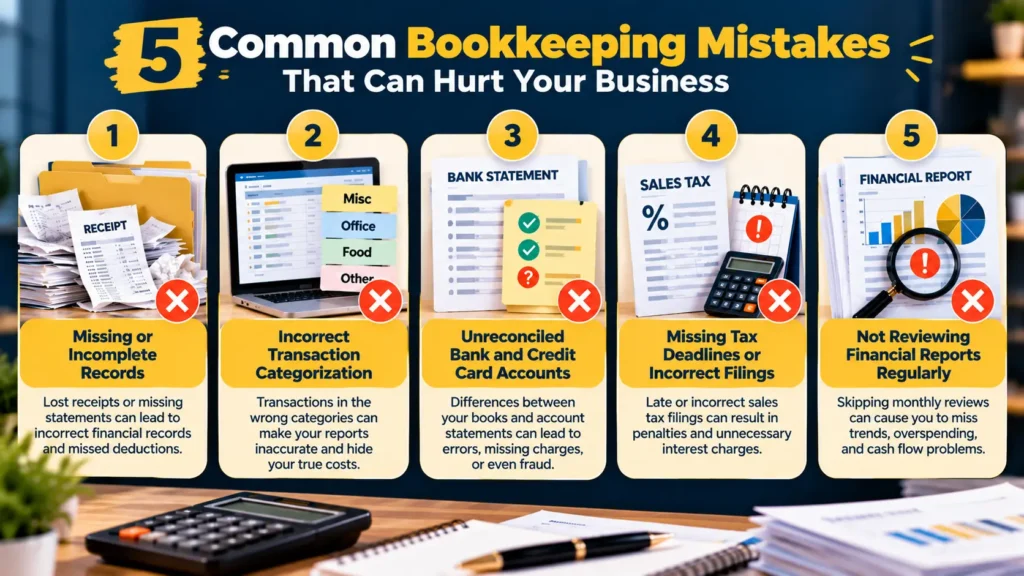
Small bookkeeping mistakes can affect your financial reports if you leave them unchecked. Here are five common mistakes and how to avoid them.
1. Skipping Reconciliations
It is easy to skip when you are busy, but accounts you have not checked against your statements can hide errors. A small mistake can sit unnoticed for months and then become hard to trace. Do it every month, even if an account has only a few transactions.
2. Mixing Personal and Business Spending
Using one account for personal and business purchases makes expenses harder to track and can cause tax problems. Keep separate accounts and cards. If you make a personal purchase using business funds, record it correctly.
3. Guessing Transaction Categories
Recording expenses in the wrong accounts can make your financial reports inaccurate. For example, a loan principal payment is not a regular business expense. Review unclear transactions and ask your bookkeeper or accountant when needed.
4. Losing Receipts and Supporting Documents
Missing receipts make it harder to confirm expenses and keep accurate records. Paper receipts can fade or get lost. Save digital copies of receipts and invoices, and keep them organized with your transactions.
5. Closing the Month Without Reviewing Reports
Even correctly recorded transactions need a final review. A sudden increase in costs or drop in profit could signal a problem. Review your financial statements and investigate unusual changes before closing the month.
What If You Are Behind? How to Catch Up
If you have missed a month or more, do not panic, and do not try to fix everything at once. Start with the oldest month. Gather the statements, check each account, and sort the transactions, then move to the next month. Handle payroll and sales tax filings first, because those have deadlines and penalties. Once you are caught up, use the checklist every month. If the amount is too large, a bookkeeper can clean up your records faster than you can and give you books that are easy to maintain.
DIY, Software, or Outsourced Bookkeeping: Which Is Right for You?
You have three main choices. You can do it yourself by hand or in a spreadsheet, use accounting software, or hire a bookkeeping firm. Doing it by hand costs the lowest amount, but takes the most time and is more likely to lead to mistakes. Software does the math and pulls in bank data, but you still have to review and sort. A bookkeeping firm does the work and checks it, so you only review the final reports.
How you keep your books also affects how useful they are. In a 2009 survey, Dorothy Davis, Paul Dunn, and Katherine Boswell asked small clothing store owners how they handled their financial records. Owners who used manual systems made reports from their data less often than owners who used computer systems, and most of the owners did not use outside help. The survey is older and covers one kind of store, but the lesson still fits. If your books are hard to keep, you will read them less and decide with less information. Get help when the checklist keeps slipping or a mistake costs you money.
Conclusion
A monthly bookkeeping checklist turns a stressful job into a simple routine. Collect your records, check your accounts, sort, check payroll and tax, read your reports, and back up. Follow the same steps every month and your books will stay accurate, tax time will be easier, and you will always know where your business stands. If you fall behind, start with the oldest month and work forward.
Need Help Staying on Top of Your Franchise Books?
BeanSquad helps single-unit and multi-unit franchise owners close their books on time every month. Our team handles the reconciliations, reports, payroll records, and tax details, so you can spend your time running your business. To get started, contact us for a free consultation. Tell us where your books stand today, and we will help you build a simple plan.
Frequently Asked Questions
What is a monthly bookkeeping checklist?
It is a list of tasks you finish every month to keep your books correct, such as reconciling accounts, sorting transactions, checking payroll and sales tax, and reviewing reports.
How long does month-end bookkeeping take?
It depends on your size. Many small businesses finish within about ten days after the month ends.
How often should I reconcile my accounts?
At least once a month for every bank and credit card account. Businesses with a lot of daily sales may also check more often, such as every week.
What documents do I need each month?
You need bank and credit card statements, loan statements, receipts, supplier bills, payroll reports, and sales reports from your point of sale system.
Can I do my own bookkeeping or should I hire someone?
You can if you have few transactions and enough time. If you are behind or run several locations, a bookkeeper saves time and trouble.
What happens if I miss a month?
Start with the oldest missing month and work forward. Handle payroll and sales tax first, since those carry penalties.