
Yes, you can catch up on franchise bookkeeping fast, often in a few weeks, if you fix things in the right order. If your books are months behind, you are not alone. Many franchise owners fall behind because they are busy running the store. This guide shows how franchise owners can catch up on bookkeeping quickly, step by step. BeanSquad works with franchise owners, so this guide focuses on things like royalties, many locations, and POS reports.
What Is Catch-Up Bookkeeping for a Franchise?
Catch-up bookkeeping means recording and checking all the money records you missed, so your books match your bank and your real sales. For a franchise, it also covers royalties, location reports, and the numbers your franchisor asks for. When you finish, you can trust your reports again.
Catch-Up vs. Cleanup: What’s the Difference?
Catch-up means adding records that are missing, and cleanup means fixing records that are wrong. Many franchise owners need both. Maybe you never recorded three months of sales, and the months you did record have mistakes too. A good plan adds the missing months first and then fixes the errors, so you do not work on the same month twice.
Why Falling Behind Costs Franchise Owners More
Falling behind costs you more because you run the business without seeing your numbers. When you cannot see which store makes money, you end up guessing. A 2009 study in the American Journal of Economics and Business Administration, led by D. Davis with P. Dunn and K. Boswell, asked small retail business owners how they keep their records. About half of them skipped computer systems and kept records by hand. Most did not use outside experts to help with their financial data. The owners who worked by hand also made reports less often than the owners who used computers. In plain words, when records are harder to handle, owners look at them less, and they use them less. For a franchise, that can mean missing a slow store or a rising cost until it hurts. A simple tip is to connect your bank accounts to accounting software, so new records come in on their own.
How to Catch Up Quickly: A Step-by-Step Plan
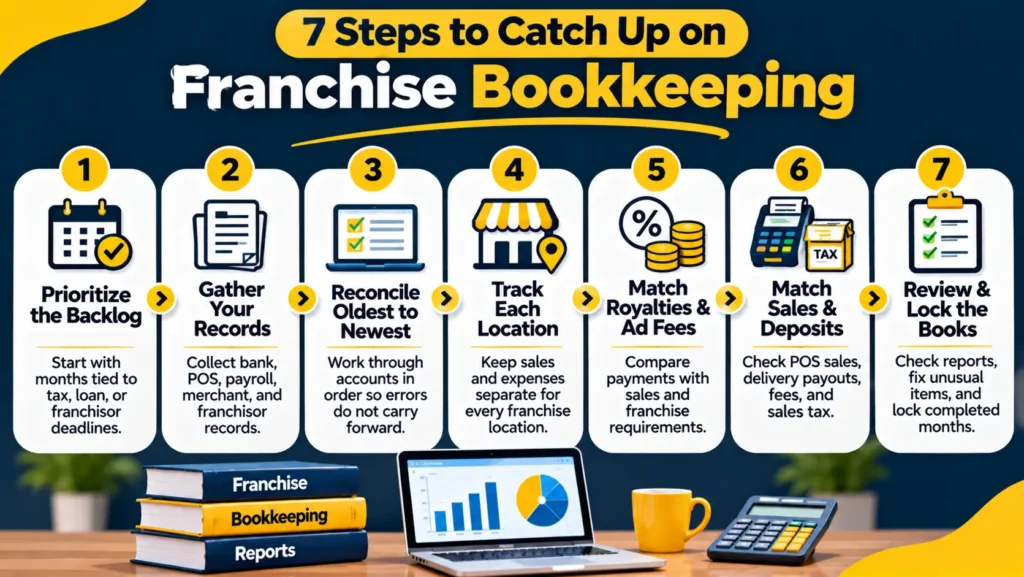
You can catch up fast by working in a set order. First sort the urgent months, then gather your records, then check each account from the oldest month to the newest. Each step below makes the next one easier.
Step 1: Sort the Backlog by Urgency
Start with the months that someone is waiting on, such as a tax filing, a loan, or your franchisor. Make a short list of how many months are behind and which ones have deadlines. This takes a day or two. It keeps you from spending a week on a month nobody needs yet.
Step 2: Gather Documents and Account Access
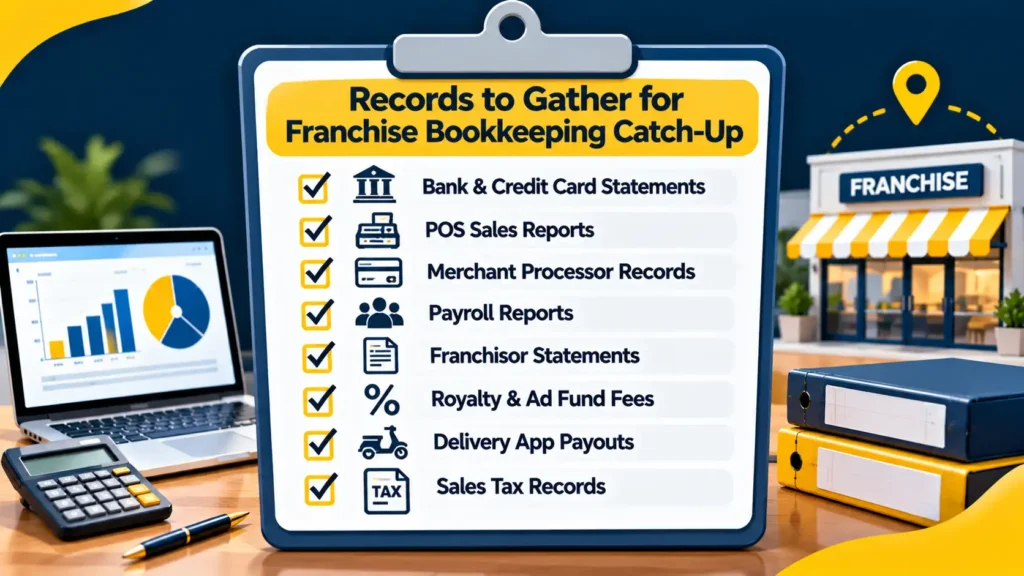
Collect your bank and credit card statements, merchant processor reports, POS reports, payroll reports, and franchisor statements. Missing papers slow everything down, so ask for them early.
Step 3: Reconcile Accounts From Oldest to Newest
Check your bank and card accounts one month at a time, starting with the oldest month. Reconciling means matching your records to your statements line by line. Order matters because each month’s ending balance becomes the next month’s starting balance. If you start in the middle, mistakes travel forward and you have to redo work.
Step 4: Set Up Tracking for Each Location
Give every location its own tracking so each store gets its own profit and loss report. Most accounting software lets you do this with classes or location tags. Set this up before you enter transactions. Otherwise you will have to sort everything again later.
Step 5: Match Royalties and Ad Fund Fees
Check each royalty and ad fund payment against your franchise agreement and your sales. Royalties are often a percent of sales, so you can test them with simple math. If a payment looks off, find out why now, before your franchisor asks.
Step 6: Match POS Sales, Delivery Apps, and Sales Tax
Compare your daily POS sales with the deposits in your bank. They rarely match exactly because of card fees, tips, delivery app cuts, and timing. Record each difference in the right account so every gap has an answer. Look at sales tax in this step too. The tax you collected should match what you report and pay, and a sales tax service can keep that in order if you want help.
Step 7: Review Reports and Lock the Months
Run your profit and loss report, balance sheet, and cash report, and read them for anything strange. Then lock the finished months so nobody changes them by accident. Now you have clean books, and you can see how each store is doing.
Franchise-Specific Catch-Up Challenges
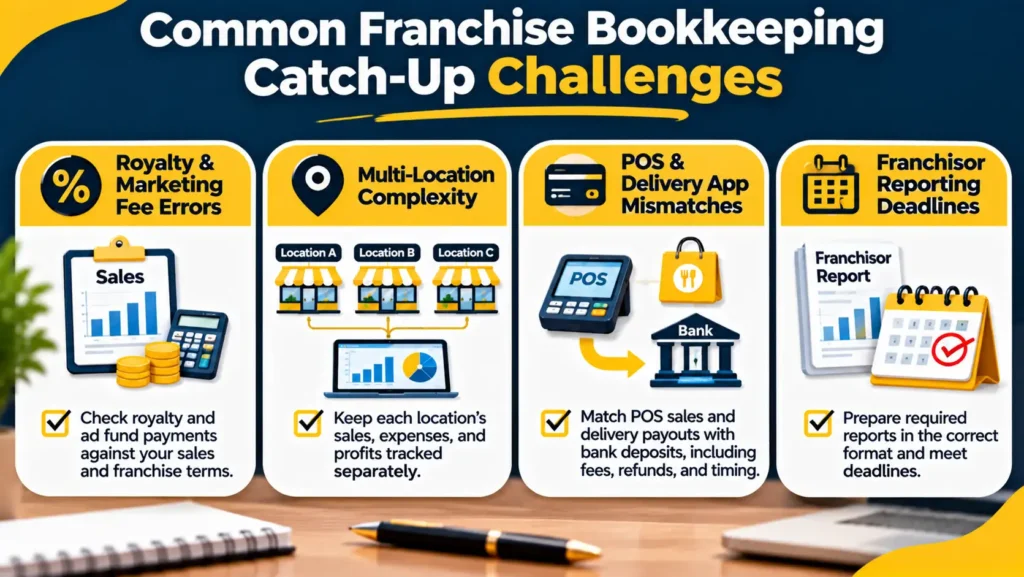
The hardest parts of franchise catch-up are royalties, many locations, sales data that does not match, and franchisor deadlines. Each one needs its own care.
Royalty and Marketing Fee Errors
Royalty errors happen when fees are coded as normal expenses or figured on the wrong sales number. Put royalties and ad fund fees in their own accounts. Then you can see exactly how much you pay your franchisor each month, and you can spot a payment that is too high or too low.
Multi-Location Complexity
Many locations get messy when money from one store gets mixed with money from another. Each store should have its own sales, costs, and bank records, while you can still see the whole business at once. A multi-location bookkeeping setup is built for this. It keeps every unit separate so you can compare stores fairly.
POS and Delivery App Mismatches
These mismatches happen because your POS shows total sales, but your bank shows money after fees and refunds. Delivery apps cause the biggest gaps, since they keep a cut and often pay you days later. Track the app fees in their own expense account, and match each payout to the app’s order report.
Franchisor Reporting Deadlines
Late franchisor reports can cause real trouble, so aim your catch-up work at those reports first. Many franchisors ask for a certain chart of accounts and regular financial reports. Ask your franchisor for a list of what is due and when, then work on those months first. Getting your records into the required format is part of franchise compliance and reporting.
How Long Does Catch-Up Bookkeeping Take?
Most franchise catch-up projects take a few weeks to a couple of months. The time depends on three things: how many months you are behind, how many locations you have, and how complete your records are. One store that is two months behind can go quickly. Five stores that are twelve months behind, with missing statements, take longer. Working in the right order and collecting documents early saves the most time.
How Much Does Catch-Up Bookkeeping Cost?
There is no single price, because cost depends on the same things as time. More months, more locations, and messier records mean more work. Ask whether a quote is a flat fee or hourly, because a flat fee tells you the total before you start.
The Hidden Cost of Staying Behind
Staying behind can cost more than the catch-up itself. Late filings can bring penalties, and missed expenses can make you pay more tax than you need to. A lender or franchisor may also not trust numbers that you cannot back up. Waiting makes the pile bigger too, since every new month adds more work.
How to Stay Current After Catch-Up
You stay current by closing your books every month, so a backlog never builds again. Turn on bank feeds so transactions arrive on their own. Pick a set day each month to review your reports, and have an accountant look over the numbers every quarter. Keep business and personal money in separate accounts. Check each location’s report, not just the total, so one weak store cannot hide behind a strong one.
Conclusion
Catching up on franchise bookkeeping is easier than it feels when you do it in order. Sort the urgent months, gather your records, reconcile from oldest to newest, and give each location its own tracking. Then keep up with a short monthly routine. Once your books are current, you can see how each store is doing and make decisions with real numbers.
Get Your Franchise Books Current
If you are behind and want help, BeanSquad is a bookkeeping and accounting firm built for the franchise industry. The team works with single and multi-location owners and can help you get current and stay that way. Contact us to talk about where your books stand and what the next step should be.
Frequently Asked Questions
What Records Should Franchise Owners Keep for Bookkeeping?
Keep proof of every sale and expense, plus your franchise agreement. Store digital copies by month, and ask your tax professional how long to keep them.
How Often Should Franchise Owners Reconcile Their Accounts?
Once a month, right after your bank statement arrives. Busy stores with many delivery app payouts can check every week.
Can Bookkeeping Errors Affect Franchise Royalty Payments?
Yes, because royalties are based on the sales you report. Wrong sales numbers can mean you pay too much or owe more later.
What Financial Reports Should Franchise Owners Review Each Month?
Review a profit and loss report for each location, plus a royalty summary, an unpaid bills list, and a sales tax summary. Together they show store profit, franchisor fees, and upcoming payments.
Can Franchise Owners Manage Bookkeeping for Multiple Locations in One System?
Yes, if each store is tracked on its own with the same list of accounts. If your locations are separate companies, keep one file for each company and combine the reports.