
A full-charge bookkeeper manages a business’s bookkeeping from recording transactions through preparing monthly financial reports. They take responsibility for the full process, rather than handling only selected tasks.
For a business owner, this means having someone manage the bookkeeping and ask for any missing records or details. The exact duties vary, so you should confirm whether payroll, bill payments, tax support, and reporting are included. This guide explains the role, how it differs from other accounting positions, and what to consider before hiring.

What Does “Full Charge” Mean in Bookkeeping?
“Full charge” means responsibility for the complete bookkeeping process. It describes the scope of the work, not a professional license or a requirement to work full time.
They may report directly to the business owner and work with an outside accountant when needed. They usually need enough experience to complete routine work independently, investigate differences, and know when to ask an accountant for help with a complex accounting issue.
However, responsibility for the books does not mean unrestricted control over business money. You should still approve payments, review reports, and make important financial decisions.
What Does a Full-Charge Bookkeeper Do?
A full-charge bookkeeper records financial activity, reconciles accounts, reviews balances, and prepares agreed reports. Payroll, billing, collections, and tax-related support may also be included.
Before hiring, put those responsibilities in writing. A job title alone does not tell you exactly what someone will handle.
Record and Categorize Transactions
They record sales, purchases, refunds, and other activity in the correct accounts. Categorizing transactions means assigning each item to the right place in your books. For example, a routine equipment repair may belong under repairs and maintenance. Buying a new piece of equipment may need different treatment.
They also maintain supporting records, such as receipts and invoices. When a transaction is unclear, they should ask for details instead of guessing.
Manage Bills You Owe and Payments Customers Owe You
A full-charge bookkeeper tracks bills your business needs to pay and payments you need to collect from customers. These are called accounts payable and accounts receivable.
They record supplier bills, check payment due dates, and prepare payments for your approval. They may also send customer invoices and reminders when payments are late. This helps you see what you owe, when bills are due, and which customers still need to pay.
Reconcile Bank and Credit Card Accounts
Bank reconciliation means comparing your accounting records with bank statements and explaining any differences. Credit card accounts need a similar review. A difference does not always mean an error. A check may be recorded in your books before it clears the bank.
The bookkeeper checks for timing differences, missing charges, duplicate entries, and other problems. They correct errors while documenting legitimate differences.
Manage Payroll Records and Tasks
They may process payroll or work with a separate payroll provider. Their responsibilities can include checking payroll reports, recording wages and taxes, and reconciling payroll balances.
If payroll processing or tax filings are included, confirm who handles each deadline and who approves the payments. For a detailed explanation of that process, see how payroll works for a small business.
Check Accounts and Update Records
A full-charge bookkeeper checks your general ledger, the main record of your business’s financial transactions. They make adjusting entries when needed to correct account balances or include missing amounts before preparing reports. For example, your business may use electricity in March but receive the bill in April. Under accrual accounting, that expense is recorded in March because that is when the electricity was used. The entries depend on how your business keeps its accounts. More complex entries may need an accountant’s review.
Prepare Financial Reports and Tax-Time Records
They prepare the reports included in their role, commonly a profit and loss statement and balance sheet. A cash flow statement or other reports may also be included.
| Report | What it tells you |
| Profit and loss statement | Revenue, expenses, and profit or loss over a period |
| Balance sheet | Assets, liabilities, and equity at a particular date |
| Cash flow statement | How cash moved through operating, investing, and financing activities |
They also organize records for your tax preparer and answer questions about the accounts. Keeping tax-ready records and preparing tax returns are separate services.
A Simple Month-End Bookkeeping Example
A full-charge bookkeeper completes the month-end close by reviewing the finished month and preparing its reports. The following fictional example shows how that work connects.
Dana owns a small retail shop. Her bookkeeper gathers the bank statements, sales records, supplier bills, and payroll reports for March.
During reconciliation, the bank statement shows $12,340, while the books show $12,890. The bookkeeper finds a $550 bank withdrawal for a supplier payment that was never recorded. Recording it reduces the book balance to $12,340.
This simplified example assumes there are no other differences, such as outstanding checks or deposits.
Next, the bookkeeper reviews unpaid bills and customer balances. Dana uses accrual accounting, so an electricity bill received in April for March usage is recorded in March.
After the remaining accounts are reviewed, the reports show $48,000 in revenue and $31,500 in expenses. The resulting profit is $16,500.
That profit is not the same as Dana’s bank balance. Some sales may remain unpaid, and cash may have been used for loan payments or equipment purchases.
The bookkeeper sends the reports with questions or notes about unusual changes. Dana can then review the results and decide what needs attention.
Full-Charge Bookkeeper vs. Bookkeeper, Accountant, and Controller
The main difference is the scope of responsibility. These roles can overlap, especially in small businesses, so compare actual duties rather than titles alone.
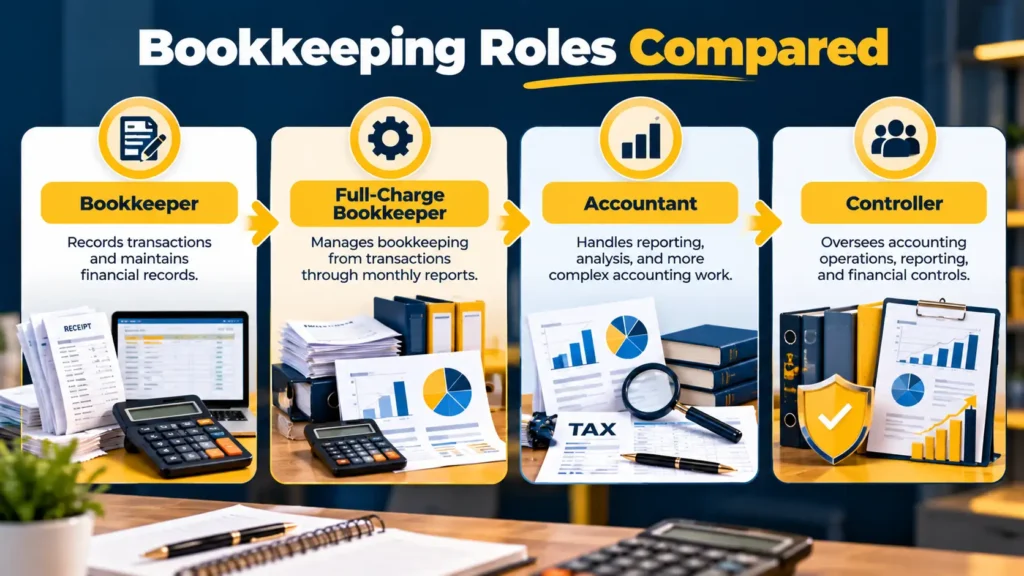
| Role | Main focus | What to clarify |
| Bookkeeper | Records transactions and maintains financial records | Whether they handle selected tasks or the whole process |
| Full-charge bookkeeper | Manages bookkeeping from recording transactions to preparing reports | Which payroll, payment, and reporting duties are included |
| Accountant | Applies accounting knowledge to reporting, analysis, and other agreed work | Whether tax preparation, planning, or complex accounting is included |
| Controller | Oversees accounting operations, reporting, and financial controls | Whether your business needs supervision of a broader accounting team |
A regular bookkeeper may already handle extensive work. “Regular” does not automatically mean inexperienced or limited to data entry.
A CPA, or certified public accountant, is a professional credential rather than a separate level in this table. A CPA may work as an accountant, controller, tax adviser, or in another role.
CPAs are licensed by state boards and must meet education, examination, and other requirements. The full-charge bookkeeper title does not provide that credential. Internal Revenue Service
Can a Full-Charge Bookkeeper Prepare Your Taxes?
A full-charge bookkeeper may prepare tax returns if they also offer that service and meet the applicable requirements. The bookkeeping title alone does not establish tax expertise.
For paid federal tax preparation, the IRS requires a Preparer Tax Identification Number, or PTIN. A preparer does not have to be a CPA or enrolled agent simply to prepare federal returns, although state requirements may also apply.
Credentials also affect a professional’s rights to represent clients before the IRS. Preparing a return and representing you during an IRS matter are different responsibilities. The IRS guide to tax preparer credentials explains that distinction. Before assigning tax work, ask about relevant training, experience, credentials, and the exact service offered.

How Much Does a Full-Charge Bookkeeper Cost?
The cost depends on the workload, location, experience required, and hiring arrangement. There is no single salary or monthly fee that fits every business.
For context, the Bureau of Labor Statistics reports a median annual wage of $50,670 in May 2025 for bookkeeping, accounting, and auditing clerks. That figure covers a broad occupational group. It is not a separate salary benchmark for full-charge bookkeepers, and it does not represent an employer’s total hiring cost.
For an employee, consider salary alongside employer payroll taxes, benefits, equipment, software, recruitment, and backup coverage. For an outside provider, ask what the quoted fee includes. Historical cleanup, payroll processing, tax work, and additional reporting may be priced separately.
The workload also changes with transaction volume, financial accounts, employees, locations, and reporting requirements. Compare quotes for the same responsibilities rather than choosing the lowest headline price.
Should You Hire In-House, Part-Time, or Outsource?
Choose the arrangement that matches your workload, support needs, and budget. Full-charge bookkeeping can be handled by an employee, an independent professional, or an outside team.
An in-house employee may suit a business with enough ongoing work to support the position. They can work closely with staff, but you need a plan for leave and turnover.
A part-time professional may suit a business that needs experienced bookkeeping support without a full-time workload. Agree on availability and deadlines, especially around the month-end.
An outsourced firm may offer several people, review processes, and backup coverage. However, those features vary by provider and should be confirmed.
Outsourcing is not automatically cheaper, and an employee is not automatically more capable. The better choice is the one that can reliably handle your agreed scope.
When Does Your Business Need Full-Charge Bookkeeping?
You may need full-charge bookkeeping when individual tasks are getting done, but nobody is responsible for completing the bookkeeping and preparing monthly reports.
Common signs include:
- Bank and credit card reconciliations remain unfinished.
- Monthly reports arrive late or need repeated corrections.
- You cannot clearly see unpaid bills or customer balances.
- Payroll records do not agree with the accounting records.
- Your accountant needs extensive cleanup before preparing returns.
- Additional locations or accounts have outgrown your current process.
These problems do not always require a new full-time employee. First determine whether the cause is a lack of accounting knowledge, unclear duties, missing records, or too much work for the current team.
For franchise owners, additional work may include tracking fees, meeting franchisor reporting requirements, and tracking each location’s sales and expenses separately. Our franchise accounting guide covers those wider responsibilities.
What Should You Check Before Hiring?
Check whether the person can complete your bookkeeping process, explain their work, and manage the complexity of your business. Relevant experience matters more than a title alone.
Ask for examples of month-end work involving businesses with similar systems, transaction volumes, or locations. They should understand your accounting software and explain how they investigate unclear balances.
Education requirements vary across bookkeeping positions. BLS notes that some employers prefer college coursework or a degree, while others accept a high school diploma. For a full-charge role, assess practical capability alongside education.
Questions to Ask a Candidate or Provider
Ask questions that reveal how they work, rather than whether they recognize accounting terms.
Useful questions include:
- Walk me through your month-end close.
- How do you investigate a bank reconciliation difference?
- Which reports would you deliver, and when?
- Who handles payroll filings and payment approvals?
- What happens when information is missing or you are unavailable?
Clear answers should describe responsibilities, review steps, and communication. Follow up when an answer is unclear or a promised deadline seems unrealistic.
Agree on Access, Approvals, and Deliverables
Set clear permissions and approval rules before work begins. Responsibility for bookkeeping should not give one person unchecked authority over payments.
Use separate user accounts and appropriate access levels where your systems support them. Decide who can create vendors, prepare payments, approve transfers, and change account details.
Also agree on reporting dates, records you must provide, cleanup work, and accountant coordination. Review the first completed month together to check that the arrangement meets your needs.
Conclusion
A full-charge bookkeeper manages your bookkeeping from recording transactions to preparing monthly reports. Payroll and tax-related work depend on the agreed duties, so confirm what is included before hiring.
If your books are behind or reports keep arriving late, start by identifying which tasks need attention. Then compare an employee, part-time professional, or outside firm based on experience, cost, and the support your business needs. Agree on clear responsibilities, reporting dates, and payment approvals before work begins.
Need Help Organizing Your Franchise Books?
BeanSquad provides franchise bookkeeping services for single-unit and multi-unit owners. We help manage the recurring bookkeeping process around your systems, locations, and reporting needs.
Tell us where your books stand and which tasks need support. Schedule a free consultation through the booking option on our website to discuss the right scope for your franchise.
Frequently Asked Questions
Is full-charge bookkeeping the same as full-cycle bookkeeping?
The terms can overlap, but they emphasize different things. “Full cycle” describes the complete sequence of bookkeeping work, while “full charge” emphasizes responsibility for handling it. Confirm the duties rather than assuming either label guarantees a specific service.
Will a full-charge bookkeeper handle everything without my input?
No. They still need complete records, explanations of unusual transactions, and timely approvals. You remain responsible for business decisions and should review the reports.
Can accounting software replace a full-charge bookkeeper?
Software can automate parts of the process, such as importing transactions and generating reports. Someone still needs to check categories, investigate differences, review balances, and resolve missing information.
Can one full-charge bookkeeper manage multiple locations?
Yes, if the workload fits their capacity and experience. More locations can require separate tracking, additional reconciliations, and consistent reporting. Larger operations may need a team or controller.
What is the difference between a full-charge bookkeeper and a controller?
A full-charge bookkeeper Handles daily bookkeeping and prepares monthly reports. A controller is a senior leader who manages the finance team, reviews the reports, and makes sure the company follows the rules. Larger companies often have both.
Can full-charge bookkeeping be outsourced?
Yes. An outside professional or bookkeeping firm can handle the full bookkeeping process. Confirm which tasks are included, when reports will arrive, and who covers the work if your main contact is unavailable.