
Yes, franchise fees are amortized. The initial franchise fee is not a normal expense. It is an intangible asset that you spread out over several years. For taxes, the IRS generally uses 15 years. In your own books, you often use the length of your franchise agreement. BeanSquad works with franchise owners every day, so this guide explains franchise fee amortization in simple words, with a real example and the mistakes to avoid.
What Does It Mean to Amortize a Franchise Fee?
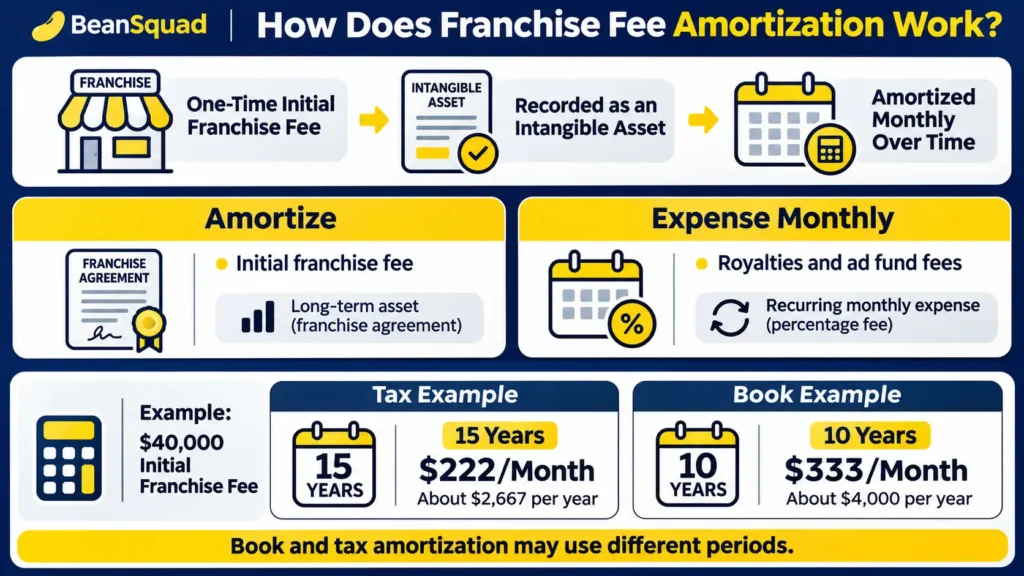
It means you spread the cost of the fee over the years you get value from the franchise, instead of counting it all in one year. Think about buying a delivery van. You do not call the whole price a cost of one year, because the van helps you for many years. The franchise fee works the same way. You paid once, but you get the brand, the training, and the business system for a long time. Amortization matches the cost to those years, so your yearly profit looks more honest.
Which Franchise Fees Are Amortized, and Which Are Expensed?
Only the one-time initial franchise fee is amortized. Ongoing royalties and ad fund fees are normal expenses, and you record them in the month you pay them. The initial fee buys you the right to use the brand for a long time, so it is treated as an asset. Royalties pay for the month you just worked, so they are a cost of that month. The initial fee is only one piece of your startup budget, and you can see the rest in this breakdown of how much it costs to become a franchise owner.
A 2001 study in the Journal of Retailing by Patrick Kaufmann and Rajiv Dant looked at franchise systems and found that the initial fee and the royalty rate rise together, even after sales are taken into account. In simple words, the upfront fee is not just a way to take extra profit from the owner. It is part of the price of the brand and the training. A simple tip is to keep the initial fee and the royalties in separate accounts so they never get mixed up.
How to Amortize a Franchise Fee Step by Step
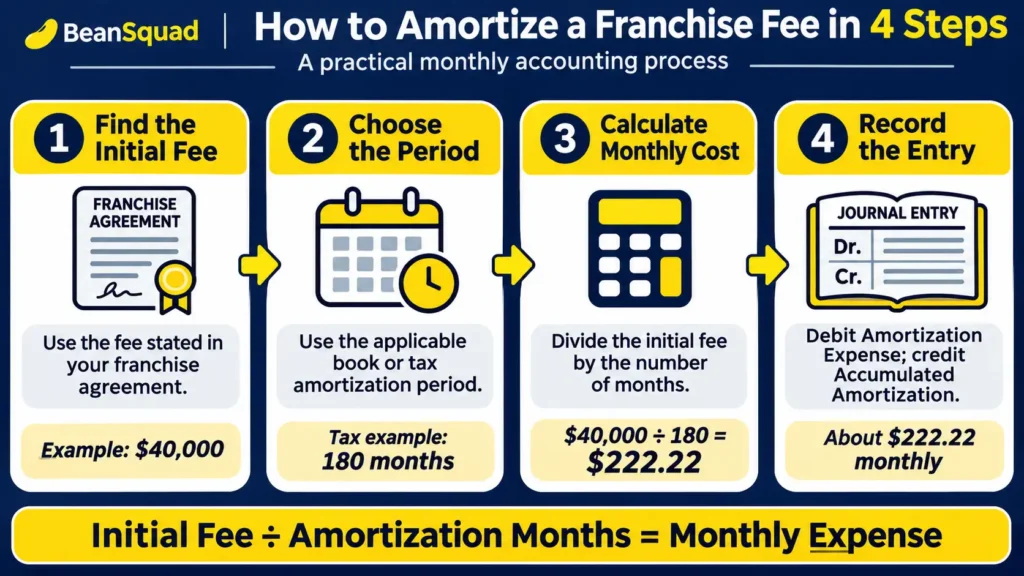
Find the amount, choose the period, divide it by the months, and record one entry each month. Each step is small, and most accounting software can repeat the entry for you.
Step 1: Find the Total Fee You Paid
Start with the initial franchise fee shown in your franchise agreement and your payment records. Use the amount you paid for the franchise rights, not your royalties.
Step 2: Choose the Amortization Period
For taxes, the period is 15 years. For your books, many owners use the length of the franchise agreement. Ask your CPA which period fits your books.
Step 3: Work Out the Monthly Amount
Divide the fee by the number of months in the period. A 15-year period has 180 months. A 10-year period has 120 months.
Step 4: Record the Entry Each Month
Each month, you debit Amortization Expense and credit Accumulated Amortization for the same amount. This lowers the value of the asset on your balance sheet a little at a time.
Franchise Fee Amortization Example
A $40,000 fee costs about $222 a month, or $2,667 a year, over the 15-year tax period. Over a 10-year agreement for your books, it is about $333 a month, or $4,000 a year. Say you sign the agreement in April. For taxes, amortization starts in the month you acquired the franchise, so the first year gets 9 months, which is about $2,000. Every full year after that gets $2,667. Each month in your books, you debit Amortization Expense and credit Accumulated Amortization by the monthly amount. After five full years on the tax schedule, about $26,667 of the fee is still left to amortize. Your books and your tax return will show different numbers, and that is normal.
Book vs. Tax Amortization: What Is the Difference?
Your books follow the useful life of the asset, which is often the agreement term, while the IRS uses a fixed 15 years. Both are correct, because they answer two different questions. One is about showing real performance, and the other is about computing your tax.
Amortization for Your Books
Your books should show the real profit of each year. That is why many owners match the fee to the length of the franchise agreement.
Amortization for Your Tax Return
Under Section 197 of the tax code, a franchise is a covered intangible, and its cost is spread evenly over 15 years. The period starts with the month you acquired it. This is true even if your agreement is shorter or longer than 15 years. You report it on IRS Form 4562. Your accountant tracks both schedules so the gap does not confuse you at tax time.
What About Training, Legal Fees, and Other Start-Up Costs?
Not every cost around buying a franchise is treated the same way. Costs you pay to the franchisor for the franchise rights are usually part of the amount you amortize. Other costs, such as start-up costs, can follow different rules. Ask your CPA to sort each cost so you do not put it in the wrong bucket.
What Happens at Renewal or Transfer?
A renewal fee or a transfer fee is generally treated like a new purchase, so it gets its own schedule. Do not add it to the old one. Start a new schedule from the month you paid it, and keep the paperwork for each fee.
If You Sell or Close the Franchise Early
When you sell or close, amortization stops, and the balance that is left is handled as part of the sale or closing. For taxes, there are special rules. For example, if you keep other covered intangibles from the same deal, the IRS can limit the loss you claim on the one you got rid of. Talk to your CPA before you sell or close.
A 2009 paper in Issues in Accounting Education by Mark Kohlbeck, Jeffrey Cohen, and Lori Holder-Webb, from Florida Atlantic University, Boston College, and Western New England University, used a pizza restaurant case about reacquired franchise rights. It showed that setting the value of franchise rights takes real judgment, and that auditors check these assets for impairment. A simple tip is to ask once a year whether your location still earns enough to support the value on your balance sheet.
Franchise Fee Amortization for Multiple Locations
Each location should have its own fee, its own schedule, and its own expense. If you own three units, you paid three fees, so you track three schedules. This keeps each store’s profit and loss report correct. A multi-location bookkeeping setup does this by tagging every entry to the right unit.
How Amortization Shows Up in Your Financial Reports
It shows as an expense on your profit and loss report, and as a lower asset value on your balance sheet. The expense lowers your profit a little each month, but no cash leaves your bank, because you already paid the fee. This is why a store can show a smaller profit and still have healthy cash. Clear franchise financial reporting separates this non-cash cost so you can read both profit and cash the right way.
Common Franchise Fee Amortization Mistakes
The biggest mistakes are expending the full fee at once, using the wrong timeline, amortizing royalties, and keeping weak records.
Expensing the Full Fee at Once
Expensing the whole fee in year one can turn a healthy profit into a loss on paper. A $40,000 fee, for example, would hit that year hard and make the later years look better than they really are. Record it as an asset and spread it over the right number of months instead.
Using the Wrong Timeline
Using 15 years in your books when you meant the agreement term, or the other way around, makes your reports and tax return disagree with no clear reason. Write down which period you chose and why.
Amortizing Royalties
Royalties are usually a percent of your sales, so they rise and fall with each month. Putting them on an amortization schedule would hide your real monthly costs. Only the initial fee gets spread out over time.
Keeping Weak Records
If you cannot find your franchise agreement or proof of payment, you cannot support your schedule. If your records are already a mess, you can catch up on franchise bookkeeping in a few weeks by fixing things in the right order.
Conclusion
Franchise fee amortization simply spreads the one-time initial fee over many years. Amortize the initial fee, expense the royalties, keep one schedule for each location, and track your book and tax numbers separately. Do this each month, and your reports will show the real health of your franchise.
Get Help With Your Franchise Books
If you own or run a franchise and want this done right, BeanSquad is the gold standard in franchise bookkeeping. It works only with franchisees and franchisors, supports the franchise industry, and can set up your schedules and keep each location clean. Contact us to discuss your franchise bookkeeping needs and how we can support your business.
Frequently Asked Questions
When Does Amortization Start?
For taxes, it starts in the month you acquired the franchise rights, which is not always the month you open. For your books, ask your CPA whether to begin at signing or at opening. Pick one rule and use it for every location.
What If I Pay the Franchise Fee in Installments?
The total cost still forms one asset, even when you pay it in parts. Ask your CPA how to start the schedule, because the timing can depend on when you acquired the rights.
Does Amortization Change My Royalty Payments?
Usually not. Royalties are generally based on your sales, and amortization does not change your sales. Check your franchise agreement to confirm how your royalty is figured.
Does Amortization Lower My Taxes?
Yes, it creates a deduction that lowers your taxable income a little each year. The savings depend on your tax situation, so ask your tax professional for the exact effect.
Should I Set Up the Schedule Myself?
Because the book and tax rules differ, it helps to have a CPA or franchise bookkeeper set it up the first time. After that, the monthly entry is routine. A wrong start is harder to fix than a right one.