

Sales tax nexus for multi-location franchises can become complicated as a business expands into new states. A new store, employee, warehouse, online customer base, or inventory location may create sales tax responsibilities that did not exist before. Sales tax nexus is the connection between a business and a state that allows the state to require sales tax registration, collection, filing, and payment. For franchise businesses, the challenge is knowing which entity has nexus, where it exists, and when the obligation begins.
The rules changed significantly after the U.S. Supreme Court’s 2018 decision in South Dakota v. Wayfair. The Court rejected the previous rule that generally required physical presence before a state could make an out-of-state seller collect sales tax. This opened the door for states to use economic activity, such as sales revenue, to establish nexus.
For multi-location franchises, nexus should not be treated as a one-time registration issue. It needs ongoing review as sales, locations, employees, and business activities change.
This guide explains what creates sales tax nexus, how economic nexus thresholds work, what franchise owners should do after nexus is triggered, and how to manage compliance across multiple states.
This article provides general information and should not replace legal or tax advice. State requirements can change, so businesses should verify current rules with state tax authorities or qualified tax professionals.
If your franchise already needs help untangling multi-state sales tax requirements, BeanSquad’s franchise sales tax services handle registration, filing, and ongoing compliance so you don’t have to track it all yourself. The rest of this guide walks through how nexus actually works, so you know what you’re dealing with either way.
What Is Sales Tax Nexus?
Sales tax nexus is a sufficient connection between a business and a state that allows the state to require the business to comply with its sales tax laws. That connection can come from physical activity, economic activity, or other business activities recognized under state law. The important point is that selling into another state does not always create the same obligation. You need to understand why nexus exists and which state rule applies.
Physical Nexus vs. Economic Nexus
Physical nexus usually comes from having a real business presence in a state. For a franchise, this might include: a store, office, warehouse, employee, inventory, or other ongoing business activity. Physical presence remains important even after Wayfair. Streamlined Sales Tax guidance explains that businesses with physical presence in a state generally do not qualify as remote sellers and may need to register regardless of their sales volume. Economic nexus works differently.
A business can create economic nexus without having a store, employee, or warehouse in the state. Sales into the state may be enough when they meet that state’s economic nexus threshold. This is especially important for franchise businesses that sell through ecommerce stores, centralized websites, marketplaces, or other channels that reach customers outside their physical locations.
How the Wayfair Decision Changed Sales Tax Nexus
Before the Wayfair decision, states generally faced stronger limits when requiring businesses without physical presence to collect sales tax. In June 2018, the Supreme Court ruled that physical presence was not required in every case for a state to establish a substantial nexus.
That decision allowed states to enforce economic nexus laws against qualifying remote sellers. The result is that a franchise may now have sales tax responsibilities in a state even when it does not operate a franchise location there.
Sales Tax Nexus vs. Franchise Tax Nexus
Sales tax nexus should not be confused with a franchise tax. Sales tax usually involves collecting tax from customers on taxable transactions and sending that money to the appropriate tax authority. A franchise tax is generally a separate state-level business tax. Despite the name, it is not limited to franchise businesses.
A company may have sales tax nexus, income tax nexus, franchise tax nexus, or several types of nexus at the same time. For this reason, franchise owners should evaluate each tax separately rather than assuming one nexus review covers every state tax responsibility.
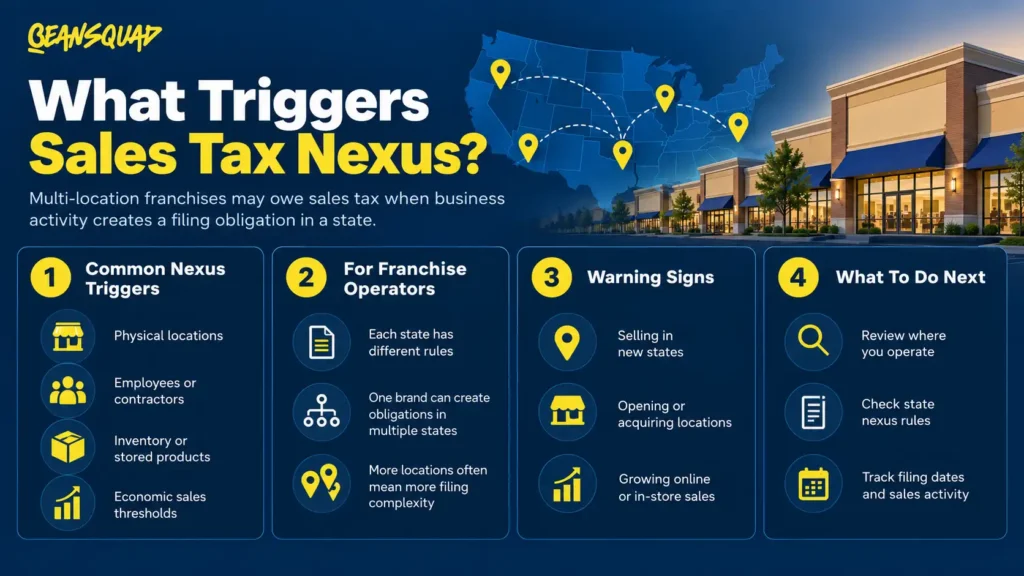
How Sales Tax Nexus Works for Franchise Businesses
Franchise businesses add another level of complexity because the franchisor, franchisee, operating company, and individual locations may not all be the same taxpayer.
Instead of asking, “Does the franchise have nexus?” owners should ask:
Which legal entity has nexus, in which state, and because of which activity? That question creates a much clearer starting point.
Franchisor vs. Franchisee Sales Tax Responsibilities
A franchisor and an independently owned franchisee are not automatically treated as one taxpayer. A franchisee may operate its own location, process its own sales, hold its own sales tax permits, and file its own returns. The franchisor may have separate responsibilities based on its own activities.
For example, the franchisor may sell products directly to customers, supply goods to franchisees, operate an ecommerce store, employ workers in another state, or store inventory there. Each activity needs to be reviewed under the law of the state involved.
Are Franchise Locations Evaluated Separately?
It depends on how the business is structured. If several locations belong to one legal entity, their activities may need to be reviewed together. If locations are held by separate entities, the nexus analysis may be different.
This is why location-level accounting is important. Franchise owners should be able to identify which entity owns each location, where revenue comes from, which sales belong to each state, and which taxpayer identification number applies. Clear multi-location bookkeeping makes that analysis much easier.
Can a Franchisee Create Nexus for the Franchisor?
A franchisee does not automatically create a nexus for the franchisor in every state. The answer depends on state law and the relationship between the businesses. States may consider direct sales, employees, representatives, inventory, services, property, solicitation, or other activities when reviewing the franchisor’s connection to the state.
Franchisors should therefore evaluate their own activity in every state where franchisees operate instead of assuming independent ownership removes all nexus risk.
What Triggers Sales Tax Nexus for a Franchise?
Economic sales thresholds receive a lot of attention, but they are only one way nexus can be created. A franchise should review both its physical and economic activity.
Physical Locations, Offices, and Warehouses
Opening a physical location usually creates a clear connection with a state. The same concern applies to offices, warehouses, storage facilities, and other business property. A company with physical presence should not assume it can wait until it crosses an economic nexus threshold before reviewing its registration requirements.
Employees, Contractors, and Representatives
Employees working in another state can also create nexus. This includes situations where a franchise has no store in the state but has a remote employee working there. Depending on state rules and the activities performed, contractors, sales representatives, service workers, or installers may also matter. As remote work becomes more common, employee location should be part of the nexus review.
Inventory and Fulfillment
Inventory is another important trigger. Products may be stored in a company warehouse, third-party fulfillment center, or marketplace distribution network. A franchise owner should know where inventory is physically located. If inventory is moved into another state, the business may create a physical connection there even if it has no customer-facing location.
Economic Nexus From Out-of-State Sales
A business can also create a nexus when sales into a state meet its economic threshold. Most states with a sales tax have established remote seller rules, but the thresholds are not identical.
For example, some states use a $100,000 sales threshold, while others use a higher amount. The sales included in the calculation and the measurement period can also differ. This makes a state-by-state review essential.
Other Activities That May Create Nexus
Other activities can also create tax exposure. These may include trade shows, installation services, repair work, affiliate relationships, temporary business activities, or certain types of in-state representation. There is no reliable one-rule-fits-all approach.
When a franchise begins meaningful business activity in a new state, nexus should be reviewed before assuming there is no obligation.

How Economic Nexus Thresholds Work
An economic nexus threshold determines when a remote seller has enough economic activity in a state to become subject to its sales tax requirements. The key issue is not simply how much money the business makes. Owners also need to know which sales the state counts.
Sales Revenue and Transaction Thresholds
Many states use a dollar-based sales threshold. Some states have historically also used transaction counts, although several have removed those tests and now rely mainly on sales revenue. This is one reason businesses should not rely on an old nexus chart. A rule that was correct several years ago may no longer reflect the state’s current requirements.
Which Sales Count Toward the Threshold?
States can calculate nexus using different types of sales.
| Threshold Type | What May Be Included |
| Gross Sales | Taxable, exempt, nontaxable, and sometimes resale sales |
| Retail Sales | Retail transactions, generally excluding sales for resale |
| Taxable Sales | Sales that are actually subject to tax |
| State-Specific Measure | A calculation defined by that state’s law |
Streamlined Sales Tax explains that a gross-sales threshold can include resale and exempt transactions, while retail-sales and taxable-sales tests can produce much lower totals.
Consider a business with $150,000 in sales into one state. If $60,000 represents resale transactions and $30,000 represents exempt sales, the amount counted toward the threshold could differ sharply depending on how the state defines qualifying sales. That is why franchise owners should not simply pull total revenue from their accounting software and compare it with every state’s threshold.
Measurement Periods Matter Too
States also use different periods to measure economic activity. A state might look at the current calendar year, previous calendar year, current or previous year, or a rolling period.
A franchise can therefore cross nexus thresholds at different times in different states even if sales are growing at a similar rate. The threshold amount, qualifying sales, measurement period, and effective registration date should all be recorded together.
How to Determine Where Your Franchise Has Nexus
A growing franchise needs a repeatable nexus review rather than an occasional check. The following process keeps the analysis manageable.
Step 1: Identify Physical Activity
Start with every state where the business has a physical connection. Review locations, offices, employees, warehouses, inventory, property, service activities, and other ongoing operations. Do this separately for each legal entity.
Step 2: Organize Sales by State and Entity
Next, organize revenue by destination state and legal entity. Company-wide revenue alone is not enough. Your accounting records should show how much each entity sells into each state. For multi-location franchises, consistent location and entity coding makes this much easier.
Step 3: Compare Sales With Current State Rules
Compare the relevant sales totals with the state’s current economic nexus threshold. Check what the state counts toward the threshold and which measurement period applies. Marketplace sales should also be reviewed because their treatment can differ by state.
Step 4: Identify When Nexus Began
Once you determine that a nexus exists, identify when it was triggered. This matters because the obligation may have started months before the review. The trigger date can affect registration, collection, filing, and potential historical exposure.
Step 5: Repeat the Review as the Franchise Grows
Nexus is not static. A new store, employee, fulfillment location, ecommerce channel, acquisition, or sales increase can change the answer. Build nexus review into expansion planning instead of waiting until a tax notice arrives.
What Should You Do After Nexus Is Triggered?
Finding a nexus is only the first step. Once a business has an obligation, it needs to determine what happens next.
Register for the Required Sales Tax Permit
The business will generally need to register with the appropriate state tax authority. Registration procedures vary by state. Businesses operating in multiple Streamlined Sales Tax member states may also be able to use the Streamlined Sales Tax Registration System. The important point is to identify the correct registration date and avoid assuming every state follows the same timetable.
Determine What Is Taxable
Nexus determines whether the state can require compliance. Taxability determines which transactions are actually taxed. Products and services can receive different treatment from one state to another. Franchise owners should classify what they sell rather than applying tax to every transaction automatically.
Apply the Correct Tax Rate and Sourcing Rule
The business then needs to determine where the transaction is sourced. Depending on the state and type of sale, the correct rate may be affected by the seller’s location, customer’s location, delivery destination, or service location. Local county, city, district, and home-rule taxes can make this more complex.
Collect, File, and Remit
Once collection begins, the business also needs a filing process. States may assign monthly, quarterly, annual, or other filing frequencies. Returns, payment confirmations, permits, notices, exemption records, and supporting calculations should be kept organized by state and legal entities. This is where structured franchise accounting becomes especially important.
How Marketplace and Online Sales Affect Nexus
Marketplace facilitator laws can make sales tax easier in some situations, but they do not remove the need for nexus analysis. Platforms that qualify as marketplace facilitators may be required to collect and remit tax on sales they facilitate for third-party sellers.
Do Marketplace Sales Count Toward Economic Nexus?
Sometimes. Some states include marketplace sales when determining whether a seller has crossed its remote seller threshold. Others treat those sales differently. This means a franchise cannot simply remove Amazon, Etsy, or other marketplace revenue from its nexus calculations. State treatment must be checked individually.
Do Marketplace Sellers Still Need to Register?
Possibly. A business that sells only through a marketplace may have different requirements from one that also makes direct sales. Streamlined Sales Tax guidance notes that marketplace sellers may still have registration or filing requirements depending on the state. A seller with physical presence may also have obligations regardless of marketplace collection.
For accounting purposes, direct sales and marketplace sales should be tracked separately. That makes it easier to determine who collected the tax and which revenue belongs in each state’s nexus calculation.
How Sales Tax Sourcing Works Across Multiple Locations
After establishing nexus, the franchise still needs to know where a transaction should be taxed. This is known as sourcing.
Origin-Based vs. Destination-Based Sales Tax
Origin-based sourcing focuses more heavily on where the seller is located. Destination-based sourcing generally follows where the buyer receives the product. The correct approach depends on the state and transaction. For franchises with ecommerce sales, delivery services, or multiple stores, the sourcing rule can directly affect the rate charged to the customer.
State and Local Sales Tax
A sales tax rate may include more than the state rate. County, city, district, and other local taxes may apply. That means two franchise locations in the same state can face different combined tax rates. Certain home-rule jurisdictions can also have additional local requirements.
For this reason, a franchise should not configure one blanket tax rate for every transaction in a state without confirming the applicable sourcing rules.
Common Sales Tax Nexus Mistakes Franchise Owners Make
Many sales tax problems begin with simple assumptions rather than complicated tax rules. One common mistake is assuming that every state uses the same economic nexus threshold. Threshold amounts, qualifying sales, marketplace treatment, and measurement periods can differ.
Another mistake is reviewing only total company revenue. Economic nexus needs state-level data. A business cannot determine whether it crossed a state’s threshold if its accounting system cannot clearly separate sales by destination.
Franchises also sometimes focus entirely on online sales and overlook physical nexus created by employees, inventory, warehouses, or other activity. Marketplace sales create another common misunderstanding. A marketplace collecting tax does not necessarily mean the seller has no remaining nexus, registration, or filing responsibilities.
Finally, businesses sometimes register as soon as they discover a problem without determining when the nexus actually began. That can be risky. If nexus was triggered in an earlier period, the franchise should understand its historical exposure before deciding how to correct the issue.
What Happens If You Miss a Nexus Obligation?
A missed sales tax obligation can become expensive because sales tax is generally collected from the customer. If the business should have collected tax but did not, it may have to pay the amount from its own funds. Interest and penalties may add to the cost. Historical exposure can also become an issue during a tax audit, business sale, financing process, or acquisition.
A potential buyer may want confirmation that sales tax permits, returns, and payments are current in every required jurisdiction.
When Voluntary Disclosure May Help
A franchise that discovers older nexus exposure should discuss its options with an experienced state tax professional before simply filing old returns. Voluntary disclosure programs may provide a structured way for eligible businesses to address past tax liabilities.
The Multistate Tax Commission operates a program that helps qualifying taxpayers address potential liabilities in participating states through a coordinated process. Prior contact with a state can affect eligibility, so timing matters.
How to Manage Sales Tax Nexus Across Multiple Locations
The best way to manage nexus is to make it part of the franchise’s normal financial process. Start with a state-by-state nexus matrix. For each state, record the legal entity, physical activity, economic threshold, qualifying sales, measurement period, marketplace treatment, nexus date, registration status, and filing frequency. Sales should also be monitored throughout the year rather than only during tax season.
If a business is approaching a state threshold, management should know before the threshold is crossed. Operational changes should trigger reviews too. Hiring an employee in a new state, opening another store, adding inventory to a warehouse, launching a marketplace channel, or acquiring another business can all change the nexus picture.
Finally, keep sales tax documents organized with the wider accounting records. Permits, returns, payments, exemption certificates, state notices, and supporting calculations should be easy to find. For franchises with many locations, centralized oversight combined with accurate location-level reporting can prevent one state’s compliance problem from becoming a larger multi-state issue.
Sales Tax Nexus Checklist for Multi-Location Franchise Owners
Before considering your nexus review complete, make sure you can answer these questions:
- Which legal entity owns or operates each location?
- In which states do we have stores, employees, inventory, offices, or other physical activity?
- How much qualifying revenue does each entity generate in each state?
- What does each state count toward its economic nexus threshold?
- What measurement period applies?
- Do marketplace sales count toward the threshold?
- When was nexus first triggered?
- Are all required sales tax registrations active?
- Are taxable products and services classified correctly?
- Are returns being filed and paid on the correct schedule?
- Will Nexus be reviewed again when the business expands?
If these answers are difficult to find, improving the underlying bookkeeping and location-level reporting should be part of the compliance plan.
Get Help Managing Franchise Sales Tax
Managing sales tax becomes harder as a franchise adds more locations, entities, sales channels, and states.
BeanSquad helps franchise owners keep sales tax records and recurring compliance work organized alongside their wider accounting processes. Clear location-level reporting can make it easier to monitor sales, identify potential nexus issues, and maintain the records needed for filings.
If your franchise operates across multiple locations or states and you need help organizing your sales tax process, schedule a free 30-minute consultation with BeanSquad.
Conclusion
Sales tax nexus for multi-location franchises is not based on one national threshold or one simple rule. A franchise can create nexus through physical locations, employees, inventory, warehouses, or economic activity in another state. Franchisors and franchisees may also have separate obligations depending on their legal structure and business activity.
Economic nexus thresholds vary by state, including which sales count and how the measurement period works. Marketplace collection does not always remove every registration or filing responsibility either. For franchise owners, the key is to track sales and physical activity by state and legal entity, identify when nexus begins, and review obligations whenever the business adds locations, employees, inventory, or new sales channels. If nexus has already been triggered, determine the effective date before registering or correcting past filings.
A structured, ongoing nexus review gives multi-location franchises a much better chance of staying compliant as the business grows.
Frequently Asked Questions About Sales Tax Nexus
Do Franchisors and Franchisees Have Separate Sales Tax Nexus?
They can. An independently owned franchisee and a franchisor may be separate taxpayers with different business activities. Each entity should be reviewed based on where it operates, sells, employs people, stores property, and conducts other business activities.
Does Opening a Franchise Location Create a Sales Tax Nexus?
A physical business location generally creates a strong nexus connection. A business with physical presence should review registration requirements rather than assuming a remote seller economic threshold protects it from an obligation.
Can One Franchise Location Create Nexus for the Entire Company?
It depends on the legal structure. If several locations operate under one entity, the activity of one location may affect that entity. Locations operated through separate entities may require separate analysis.
Do Online Sales Count Toward Economic Nexus?
Yes, qualifying online sales into another state can create an economic nexus when the state’s threshold is met. The amount, sales included, and measurement period depend on the state.
Do Exempt or Resale Sales Count Toward Nexus Thresholds?
Sometimes. States using gross sales may include exempt and resale transactions, while states using retail or taxable sales may calculate the threshold differently.
Does Amazon or Etsy Collect Sales Tax for Sellers?
Marketplace facilitators may be responsible for collecting and remitting sales tax on qualifying marketplace transactions. Sellers can still have separate nexus, registration, filing, or direct-sales obligations depending on the state.
When Do Economic Nexus Thresholds Reset?
There is no universal reset rule. States may use calendar-year periods, previous-year periods, or rolling measurement periods. Each state’s rule should be checked separately.
What Should I Do If My Franchise Already Crossed a Threshold?
First determine when nexus began and what sales were affected. Then review the potential registration, filing, tax, interest, and penalty exposure with a qualified tax professional before deciding how to correct prior periods.